
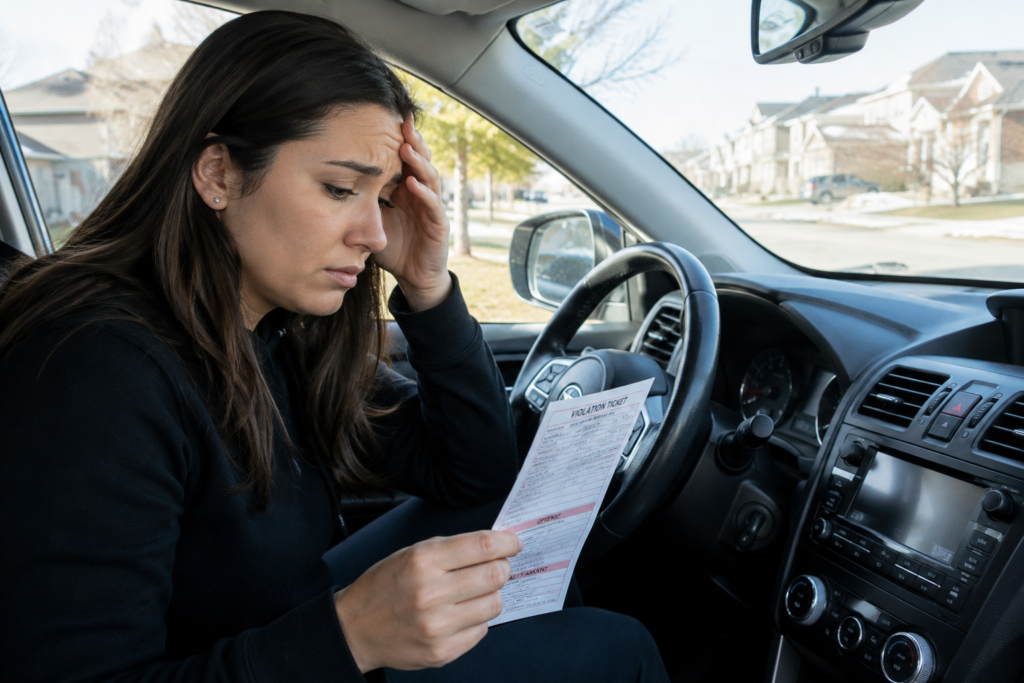
On March 13, 2026, Alberta raised traffic fines for the first time since 2015 — some offences jumped by 30 to 50 percent. If you have looked at a recent speeding ticket and winced, that is by design. But here is the part most drivers get wrong: the fine printed on the ticket has never been the expensive part. The real cost shows up later, on your insurance renewal and your driving abstract, and it can outlast the fine by years.
Executive Summary
Alberta raised speeding fines on March 13, 2026, but the fine itself is rarely the real cost. This post breaks down the current fine schedule, how demerit points and insurance surcharges compound over time, and how to decide whether paying a ticket or fighting it makes more sense for your situation.
In This Article
This is a breakdown of what a speeding ticket in Alberta actually costs you — the fine, the demerits, and the insurance hit — and how to think about whether paying it is really the cheap, easy option it looks like.
The fine is the smallest number on the page
Alberta\’s speeding fines scale with how far over the limit you were caught. The amounts below are the current provincial figures published by the Government of Alberta, and they already include the 20 percent Victims of Crime surcharge.
| Kilometres over the limit | Fine | Fine near workers / emergency responders |
|---|---|---|
| 1 km/h over | $105 | $211 |
| 10 km/h over | $144 | $288 |
| 20 km/h over | $228 | $456 |
| 30 km/h over | $324 | $648 |
| 40 km/h over | $560 | $1,120 |
| 50 km/h over | $774 | $1,200 |
| 51+ km/h over | Mandatory court appearance — fine set at the court\’s discretion |
Two things worth noticing. Fines near construction workers or emergency responders roughly double, so a moment of inattention through a work zone gets expensive fast. And at 51 km/h or more over the limit, you are no longer dealing with a payable ticket at all — that is a mandatory court date, and the fine is whatever the judge decides.
Still, even $774 is not what makes a speeding ticket costly. What makes it costly is what the conviction does to the two records that follow you around: your demerit count and your abstract.
Demerits: a two-year clock you cannot pay off
A speeding conviction adds demerit points based on how far over you were:
- 2 points — up to 15 km/h over
- 3 points — 16 to 30 km/h over
- 4 points — 31 to 50 km/h over
- 6 points — 51 km/h or more over
Those points land on your record on the date of conviction and stay there for two years. A fully licensed (Class 5) driver who reaches 15 points in a two-year window is automatically suspended for a month; for drivers still in the Graduated Driver Licensing program, the threshold is just 8. And when a demerit suspension ends, your licence comes back with 7 points already on it — so you start the next two years halfway to another suspension. Paying the ticket does not slow this clock down. Paying is the conviction.
The part that actually hurts: your insurance
Here is where the math turns. In Alberta, insurers do not price your policy off demerit points — they price it off convictions on your record. A single speeding conviction can raise your premium by roughly 25 percent, and the Insurance Bureau of Canada notes that a conviction can affect your rates for up to three years.
Run that out. Say your premium is $2,000 a year. A 25 percent surcharge is about $500 more per year — and if it rides your policy for three renewals, that is roughly $1,500 in extra premium from one ticket. Suddenly a $228 fine for 20 over is the down payment on a $1,700-plus problem. Stack a second conviction inside that same window and many insurers stop treating you as a routine risk altogether; a few will decline to renew.
| What you see | What it actually costs over 3 years |
|---|---|
| Fine for 20 km/h over | $228 (one-time) |
| Demerits (3 points) | On your record 2 years; pushes you toward suspension |
| Insurance surcharge (~25% on a $2,000 premium) | ~$500/year × up to 3 years ≈ $1,500 |
| Real total | Often 7–8× the fine |
The exact surcharge depends on your insurer, your history, and the specific conviction — this is an illustration, not a quote. But the shape of it holds: for most drivers, the insurance consequence dwarfs the fine.
So should you pay it, or fight it?
Paying looks like the frictionless choice. It is also an admission of guilt that locks in every downstream cost above. Fighting keeps the conviction off your record — if it works — but it takes a response before your deadline (usually about 30 days on the ticket) and, realistically, some knowledge of how disclosure and Alberta traffic court actually work.
| Just pay it | Fight it | |
|---|---|---|
| Upfront effort | None | Request disclosure, schedule a trial or hire representation before the deadline |
| Conviction on abstract | Yes — immediately | Avoided if the charge is withdrawn or dismissed |
| Demerits | Applied on conviction | Avoided or reduced if the outcome changes |
| Insurance impact | Full surcharge, up to 3 years | Avoided if there is no conviction |
| Best for | Drivers who value zero effort over the record | Drivers whose insurance, licence, or job is on the line |
One thing to be honest about: fighting a ticket in Alberta got harder in 2023, when prosecutors lost most of their discretion to offer no-demerit resolutions. That does not mean tickets are unwinnable — disclosure problems, procedural errors, and evidence issues still get charges reduced or dropped — but it does mean the days of a quick, guaranteed deal at the counter are gone. No one can promise you a particular outcome, and anyone who does is selling something.
What we\’d actually recommend — based on your situation
You were caught a few km/h over and have a clean record. A single minor conviction may not move your premium much, and 2 points is survivable. Fighting can still be worth it to keep the record spotless, but this is the one case where paying is a defensible call. Check what your insurer does with a single minor conviction before you decide.
Your job depends on your licence or abstract. Commercial drivers, anyone holding a Class 1–4, delivery and rideshare drivers, and people whose employer pulls their abstract should treat almost any conviction as worth fighting. A stained abstract can cost you the job long before demerits cost you the licence.
You\’re a new or GDL driver. With an 8-point suspension threshold, a single 3- or 4-point speeding conviction puts you dangerously close to losing your licence. Fight it — the downside of a suspension during GDL is far bigger than the ticket.
You were clocked at 51+ km/h over, or charged with racing or stunting. This is mandatory-court territory with 6 demerits and, potentially, a roadside suspension. Do not walk into that courtroom alone and unprepared. This is the situation where representation matters most.
You already paid it. Unfortunately, payment is treated as a conviction, and reopening it is difficult. The honest answer is that there is usually little left to work with — which is exactly why the decision matters before you pay.
The bottom line
The fine on a speeding ticket is the number Alberta wants you to focus on. The number that actually matters is the one your insurer applies at renewal, quietly, for the next three years. Before you pay a ticket to make it go away, it is worth finding out what that ticket is really going to cost — and whether it can be kept off your record.
Alberta Ticket Defense reviews Calgary and Alberta-wide traffic matters on a flat-rate basis, and the first consultation is free. If you have a ticket and a deadline coming up, get a straight read on your options before that deadline passes. Call Waqar Ahmed at (403) 926-5029 or email ticketdefend@gmail.com. No outcome is guaranteed — but paying without knowing what you are giving up rarely is the cheap option it looks like.
This article is general information about Alberta traffic matters and is not legal advice.